
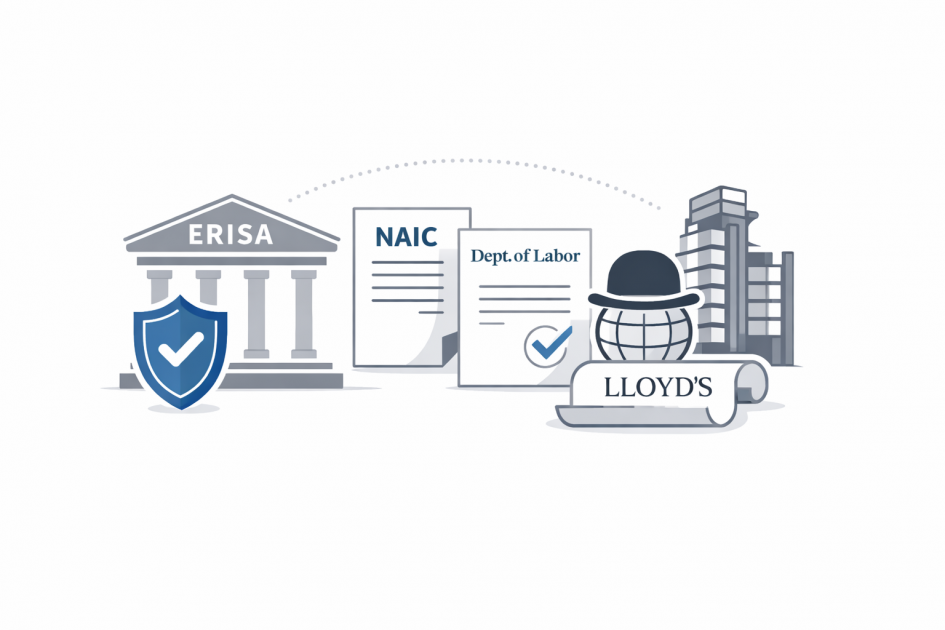
ERISA Fidelity Bonds and Lloyd’s of London Approval Requirements, NAIC Alien Insurer Eligibility, and Department of Labor Compliance Standards for Section 412 Bonding
The ERISA fidelity bond sits at a regulatory crossroads where employee benefits law borrows the risk transfer mechanics of surety and fidelity insurance to protect plan assets from internal dishonesty. The threshold question, Can ERISA fidelity bonds be written by Lloyd’s, is not merely academic. It is operational. It determines whether plan sponsors and their advisers can access Lloyd’s capacity for fidelity risks, and it clarifies what compliance looks like when the bond is not issued by a conventional United States Treasury-listed (“T-List“) corporate surety. Properly framed, the answer is yes, Lloyd’s can write ERISA fidelity bonds, but only under specific regulatory conditions that substitute a narrow exemption pathway for the default statutory rule. Those conditions now have modern, concrete contours following the Department of Labor’s Advisory Opinion 2024 01A, which addresses how Lloyd’s may satisfy the licensing and filing requirements embedded in the Department’s longstanding Lloyd’s exemption regulations. (U.S. Department of Labor, 2024).
The baseline rule under ERISA Section 412
ERISA Section 412 requires every fiduciary and every person who handles plan funds or other plan property to be bonded, and it mandates that the bond protect the plan against loss by reason of fraud or dishonesty. (U.S. Department of Labor, 2008). ERISA then tightens the acceptable surety requirement. The statute states that any bond shall have as surety a corporate surety company that is acceptable on federal bonds under authority granted by the Secretary of the Treasury pursuant to 31 U.S.C. Sections 9304 through 9308. (29 U.S.C. § 1112; 31 U.S.C. § 9304). In practice, that statutory design drives many buyers toward Treasury’s published list of certified companies, commonly called Circular 570, because federal bond acceptability is administered through Treasury’s certification framework. (U.S. Department of the Treasury, Bureau of the Fiscal Service, 2025).
At first glance, this seems to foreclose Lloyd’s. Lloyd’s is a market of syndicates and underwriting members, not a single domestic corporate surety company that appears as a certified company on Circular 570. That is exactly why the Department’s regulations created a tailored exemption for Underwriters at Lloyd’s, London. The regulations do not deny the statutory rule. They create a conditional compliance pathway that recognizes Lloyd’s as an acceptable surety for ERISA bonding when specified safeguards are met. (U.S. Department of Labor, 2024).
The controlling regulatory architecture: the Lloyd’s exemption and its conditions
The Department’s temporary bonding rules include a Lloyd’s specific exemption. The exemption provides that bonding arrangements with Underwriters at Lloyd’s can satisfy ERISA bonding requirements, but only on conditions. (29 C.F.R. § 2580.412 25; 29 C.F.R. § 2580.412 26).
Those conditions are the real compliance fulcrum. The conditions require, first, that Underwriters at Lloyd’s, London continue to be licensed in a state of the United States to enter into bonding arrangements of the type required by ERISA. Second, they require the filing of annual statements with the Department that mirror what would be required to be filed with the commissioners of insurance of the states in which Lloyd’s is licensed. (29 C.F.R. § 2580.412 26; U.S. Department of Labor, 2024).
Historically, those conditions were satisfied through Lloyd’s admitted licensing in one or more U.S. jurisdictions and the associated annual statement filings. Advisory Opinion 2024 01A addresses what happens when Lloyd’s underwriters allow certain state licenses to lapse and seek to rely instead on their surplus lines authorization pathway. The Department’s answer is the critical modern development for anyone arguing that ERISA fidelity bonds can be written by Lloyd’s today. (U.S. Department of Labor, 2024).
Advisory Opinion 2024 01A: Why the Department recognizes NAIC authorization as a functional substitute
Advisory Opinion 2024 01A responds to an inquiry on behalf of Lloyd’s regarding the conditions of the Lloyd’s exemption in 29 C.F.R. §§ 2580.412 25 and 2580.412 26. The opinion restates ERISA’s baseline corporate surety requirement and then centers on the exemption’s two conditions, licensing and annual statement filing. (U.S. Department of Labor, 2024).
The core holding is practical and compliance-enabling. The Department concludes that the NAIC International Insurers Department, acting through its Plan of Operation and the Quarterly Listing of Alien Insurers, functions on behalf of state departments of insurance in a way that, in effect, licenses Lloyd’s syndicates to write direct surplus lines business, including surety bonds, across U.S. states and territories. (U.S. Department of Labor, 2024). The opinion explains that to write fidelity bonding coverage as surplus lines business in the United States, Lloyd’s syndicates must be listed as eligible surplus lines insurers on the NAIC Quarterly Listing, and that Lloyd’s syndicates must provide extensive market-level and syndicate-level information to enter and remain on that listing, including information tied to U.S. trust accounts and ongoing disclosures. (U.S. Department of Labor, 2024; National Association of Insurance Commissioners, 2026).
Based on that structure, the Department states that it will treat the NAIC authorization as satisfying the exemption condition that Lloyd’s underwriters be licensed in a state of the United States to enter into bonding arrangements of the type required by ERISA. (U.S. Department of Labor, 2024). The Department also concludes that, for the annual statement filing condition, Lloyd’s can satisfy the requirement by submitting the website address where the NAIC Quarterly Listing can confirm NAIC-approved status and by providing a copy of Lloyd’s annual market-level filings with the NAIC that provide transparency and disclosure functions like annual statements filed with state insurance departments. (U.S. Department of Labor, 2024).
In short, Advisory Opinion 2024 01A does not rewrite ERISA Section 412. It operationalizes the existing regulatory exemption by recognizing the NAIC surplus lines eligibility regime as the functional mechanism that satisfies the exemption’s licensing and disclosure aims, provided Lloyd’s remains properly listed and continues required filings. (U.S. Department of Labor, 2024).
The affirmative case for approval: what “yes” means in compliance terms
An argument that ERISA fidelity bonds can be written by Lloyd’s is strongest when it is framed as a compliance logic syllogism anchored in authoritative texts. First, ERISA requires fidelity bonding to protect plans against losses caused by fraud or dishonesty by persons who handle plan property. (U.S. Department of Labor, 2008). Second, the statute generally requires that the surety be acceptable on federal bonds under Treasury authority. (29 U.S.C. § 1112; 31 U.S.C. § 9304). Third, the Department’s regulations expressly provide a conditional exemption whereby arrangements with Underwriters at Lloyd’s of London satisfy ERISA bonding requirements. (29 C.F.R. § 2580.412 25). Fourth, Advisory Opinion 2024 01A clarifies that Lloyd’s may satisfy the exemption’s licensing and annual statement filing conditions through NAIC authorization and NAIC-related filings and availability, rather than only through maintaining a traditional admitted license in specific states. (U.S. Department of Labor, 2024). Therefore, an ERISA fidelity bond written in the Lloyd’s market can be compliant when it is written within the Lloyd’s exemption framework, and the conditions are met as described by the Department. (U.S. Department of Labor, 2024).
This is not a policy preference. It is a regulatory interpretation from the agency charged with administering Title I of ERISA. The Department also underscores that the opinion is limited to Title I and does not resolve how any other federal or state law might treat a particular arrangement. That caveat should be treated as a scoping statement, not a defect. ERISA bonding compliance is the target question here, and the Department’s opinion addresses precisely that. (U.S. Department of Labor, 2024).
Under what conditions, specifically, Lloyd’s written ERISA fidelity bonds are supportable
A compliant Lloyd’s pathway can be described as a checklist of conditions that map directly to ERISA Section 412, the Lloyd’s exemption regulations, and Advisory Opinion 2024 01A.
The bond must be an ERISA fidelity bond in substance, not a look-alike policy. It must protect the plan against losses due to fraud or dishonesty by persons who handle plan funds or property, as the Department explains in its Field Assistance Bulletin guidance. (U.S. Department of Labor, 2008).
The placement must fall within the Lloyd’s exemption regime. The bond must be issued as an arrangement with Underwriters at Lloyd’s of London that otherwise complies with the applicable bonding rules except for the corporate surety requirement that is the subject of the exemption. (29 C.F.R. § 2580.412 25; U.S. Department of Labor, 2024).
The licensing condition must be satisfied either traditionally or via the NAIC mechanism recognized by the Department. The regulation requires Lloyd’s underwriters to be licensed in a U.S. state to enter into bonding arrangements of the type required by ERISA. (29 C.F.R. § 2580.412 26). Advisory Opinion 2024 01A states that the Department will treat NAIC authorization, specifically eligibility through the NAIC International Insurers Department and inclusion on the NAIC Quarterly Listing, as satisfying that licensing condition. (U.S. Department of Labor, 2024; National Association of Insurance Commissioners, 2026).
The disclosure and annual statement condition must be satisfied in the manner the Department describes. The regulation requires filing annual statements with the Department. (29 C.F.R. § 2580.412 26). Advisory Opinion 2024 01A states that submitting the website address for the NAIC Quarterly Listing to confirm NAIC-approved status and providing Lloyd’s annual market-level filings with the NAIC will satisfy the filing condition, because those filings provide transparency and disclosure functions comparable to state annual statements. (U.S. Department of Labor, 2024).
The Lloyd’s syndicate eligibility must remain current. Advisory Opinion 2024 01A makes clear that the ability to write fidelity bonding as surplus lines business depends on being listed as eligible on the NAIC Quarterly Listing, and it describes delisting risk if compliance or solvency concerns arise under the NAIC oversight process. (U.S. Department of Labor, 2024; National Association of Insurance Commissioners, 2026). In compliance practice, this means a plan fiduciary cannot treat Lloyd’s acceptability as a static fact. It is a status that must be verified at placement and monitored at renewal.
Why this matters for ERISA plan fiduciaries and advisers
The compliance benefit of the Lloyd’s pathway is increased access to capacity and specialist underwriting for fidelity risks, while preserving the regulatory objectives behind ERISA bonding, namely protection of plan assets and credible solvency oversight. Advisory Opinion 2024 01A ties that oversight to concrete mechanisms, including NAIC eligibility standards, financial submissions, and U.S. trust structures described in the opinion and reflected in NAIC listing documentation. (U.S. Department of Labor, 2024; National Association of Insurance Commissioners, 2026).
Equally important, the Department’s own guidance reminds practitioners that ERISA fidelity bonds are distinct from fiduciary liability insurance. Conflating the two is a recurring compliance error. A Lloyd’s bond that meets the exemption conditions can satisfy ERISA Section 412, but fiduciary liability coverage does not substitute for the statutory fidelity bond requirement. (U.S. Department of Labor, 2008).
ERISA fidelity bonds can be written by Lloyd’s, but only through the narrow doorway ERISA itself leaves open via the Department’s Lloyd’s exemption regulations. The default statutory expectation is a Treasury acceptable corporate surety, yet the Department’s regulations allow Underwriters at Lloyd’s, London to serve as the surety when the exemption conditions are met. Advisory Opinion 2024 01A provides the most current and authoritative operational guidance on those conditions, confirming that NAIC authorization and NAIC-related disclosures can satisfy the licensing and annual statement filing requirements embedded in 29 C.F.R. § 2580.412 26. In practical compliance terms, approval exists when the bond is substantively a fidelity bond protecting the plan against fraud and dishonesty, when the Lloyd’s placement is made under the exemption framework, and when the relevant syndicates are eligible under the NAIC Quarterly Listing and the Department’s recognized filing and verification steps are followed. (U.S. Department of Labor, 2024; U.S. Department of Labor, 2008; 29 U.S.C. § 1112).
~ C. Constantin Poindexter, MA, JD, CPCU, AFSB, ASLI, ARe, AINS, AIS, CPLP
Bibliography
- National Association of Insurance Commissioners. (2026). Quarterly Listing of Alien Insurers, January 2026.
- U.S. Department of Labor, Employee Benefits Security Administration. (2008). Field Assistance Bulletin No. 2008 04: Guidance on ERISA Fidelity Bonding Requirements.
- U.S. Department of Labor, Employee Benefits Security Administration. (2024). Advisory Opinion 2024 01A.
- U.S. Department of the Treasury, Bureau of the Fiscal Service. (2025). Circular 570: Companies Holding Certificates of Authority as Acceptable Sureties on Federal Bonds and as Acceptable Reinsuring Companies.
- United States Code. (n.d.). 29 U.S.C. § 1112, Bonding.
- United States Code. (n.d.). 31 U.S.C. § 9304, Surety corporations.