
When the Supreme Court resolves a question that has divided arbitrators and circuit courts for years, the immediate beneficiaries are the litigants—but the lasting effect falls on everyone who manages risk inside the ERISA system. The Court’s unanimous decision in M&K Employee Solutions, LLC v. Trustees of the IAM National Pension Fund, 608 U.S. (2026), is one such ruling (M&K Employee Solutions 2026). On its surface, the case is a technical dispute about when a pension actuary may select the assumptions used to value a withdrawing employer’s liability. Beneath the surface, it recalibrates the exposure landscape for contributing employers, plan trustees, and the fiduciaries who steward employee benefit plans. Understanding the decision—and, just as importantly, understanding what it does not change about how plans must be protected—is essential for any sponsor or fiduciary thinking seriously about ERISA risk transfer.
The Statutory Architecture of Withdrawal Liability
The Employee Retirement Income Security Act of 1974, as amended by the Multiemployer Pension Plan Amendments Act of 1980 (MPPAA), imposes a particular obligation on employers that exit an underfunded multiemployer plan. When such an employer withdraws, it must pay “withdrawal liability”—its allocable share of the plan’s unfunded vested benefits (29 U.S.C. § 1381). The size of that obligation depends on a valuation performed “as of” a statutory measurement date, typically the last day of the plan year preceding the withdrawal (29 U.S.C. § 1391).
The valuation, in turn, rests on actuarial assumptions. Of these, the interest (or discount) rate is the most consequential. ERISA requires that the actuary use assumptions and methods that are, in the aggregate, reasonable and that “offer the actuary’s best estimate of anticipated experience under the plan” (29 U.S.C. § 1393). A discount-rate assumption is not a neutral arithmetic choice. Because it discounts the present value of vested benefits while leaving the value of plan assets untouched, even a modest change can swing the liability figure dramatically. In M&K, the IAM Fund’s actuary lowered the assumed rate by 100 basis points, from 7.5 percent to 6.5 percent, for withdrawals occurring in 2018 (Goldowitz 2026). The effect on M&K was severe: its liability rose more than threefold, from roughly $1.8 million to $6.2 million (Goldowitz 2026).
The legal fight was about timing. The actuary had not formally adopted the lower rate by the December 31, 2017 measurement date; the assumption was settled in early 2018, after the fact. M&K argued that the statute’s “as of” language froze not only the facts to be considered but also the assumptions to be applied—meaning the prior 7.5 percent rate had to govern.
What the Court Decided
The Court rejected that reading and held, unanimously in an opinion by Justice Jackson, that ERISA does not require the actuarial assumptions used in a withdrawal-liability calculation to be selected on or before the measurement date (M&K Employee Solutions 2026). The phrase “as of,” the Court reasoned, fixes the facts an actuary may consider to those in existence on the valuation date, but it does not dictate when the valuation itself must be performed or when the assumptions must be chosen. A valuation may be completed after the measurement date so long as it reflects only information available as of that date.
Two further points anchored the decision. First, an assumption is not a fact. It is a forward-looking estimative tool adopted when the need for a valuation arises. Second, the statute’s “best estimate” standard would be undermined by a rigid timing rule, because relevant data are often unavailable until after the measurement date. Forcing an actuary to lock assumptions prematurely could produce figures that no longer represent her genuine best estimate—an outcome the Court described as creating an incoherent statutory scheme (M&K Employee Solutions 2026). As commentators have noted, the ruling aligns judicial doctrine with longstanding actuarial practice and with the position urged by the Pension Benefit Guaranty Corporation (Faegre Drinker Biddle & Reath 2026).
The practical lesson for the regulated community is unambiguous: the assumptions that determine an employer’s exit cost can legitimately be set and revised in the period following the measurement date. The consequence is greater uncertainty for withdrawing employers and a larger universe of actuarial discretion whose reasonableness fiduciaries and counsel must monitor.
Two Distinct Protections Inside ERISA
This heightened-exposure environment is the right backdrop against which to understand two often-confused instruments that ERISA contemplates: the fidelity bond and fiduciary liability insurance. They protect different parties against different perils, and conflating them is a common—and costly—error.
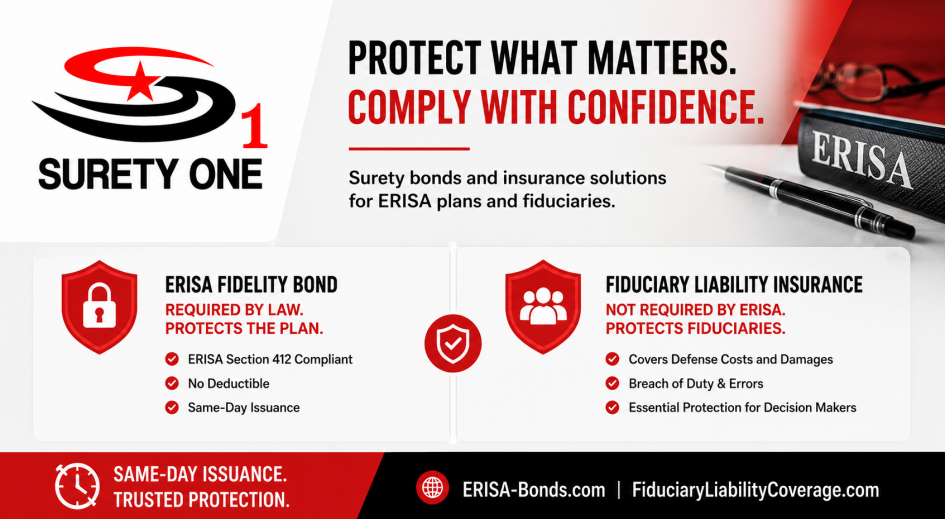
The ERISA fidelity bond is a statutory mandate. Section 412 of ERISA requires that every person who handles plan funds or property be bonded against loss from fraud or dishonesty (29 U.S.C. § 1112). The bond protects the plan itself. Its amount must be at least 10 percent of the funds handled, subject to a $1,000 floor and a $500,000 ceiling, raised to $1,000,000 for plans holding employer securities (ESOPs), and it may carry no deductible (U.S. Department of Labor 2008). The bond is a three-party suretyship in which the plan is the protected obligee, the handler is the principal, and a Treasury-listed surety guarantees performance.
Fiduciary liability insurance is different in kind. It is not required by ERISA and is not governed by Section 412. It protects fiduciaries (and derivatively the plan) against liability arising from a breach of the duties that ERISA imposes on those who exercise discretionary authority over a plan or its assets (29 U.S.C. § 1002(21)). Where the fidelity bond answers for theft, fiduciary liability coverage answers for alleged imprudence, disloyalty, conflicted decision-making, and the defense costs that accompany breach-of-duty litigation. A loss covered by one is, as a rule, not a loss covered by the other.
Where M&K Meets the Fidelity Bond
It would be inaccurate to claim that M&K expands what an ERISA fidelity bond covers; the decision concerns withdrawal-liability valuation, not fraud or dishonesty. The connection is structural rather than direct. M&K is one feature of an environment in which multiemployer plan funding, governance, and compliance are under sustained pressure, and that pressure heightens the importance of getting every foundational ERISA obligation right. The Section 412 bond is the baseline compliance requirement that applies to every covered plan regardless of its funding posture, and lapses remain a frequent audit and Form 5500 finding. Sponsors and administrators navigating a more demanding ERISA landscape cannot afford to leave the simplest mandate unsatisfied. Surety One, Inc. issues fully compliant, Treasury-listed fidelity bonds, same-day issuance, at https://ERISA-Bonds.com, allowing plan officials to close that exposure before it becomes a regulatory problem.
Where M&K Meets Fiduciary Liability Coverage
The decision’s tighter nexus is with fiduciary liability. By confirming that actuaries may adopt and revise assumptions after the measurement date, M&K enlarges the zone of discretionary judgment surrounding plan funding and, with it, the surface area for disputes. Decisions about assumption-setting, the reasonableness of a discount rate, the monitoring of actuarial work, and the prudence of plan administration are precisely the kinds of fiduciary acts that generate breach-of-duty claims. A more contested and consequential valuation environment is, almost by definition, a more litigious one.
Candor is essential here, and it is what distinguishes sound counsel from a sales pitch. Withdrawal liability itself is generally not insurable under a fiduciary liability policy. It is the contributing employer’s statutory contribution obligation, a debt owed to the plan, not a loss arising from a fiduciary’s breach of duty, and standard fiduciary forms exclude obligations to fund benefits or pay contributions. What fiduciary liability insurance does address is the adjacent and growing risk: the cost of defending and resolving claims that fiduciaries mismanaged the plan, mishandled the very assumptions and funding decisions M&K now spotlights, or failed to act prudently as exposures mounted. In an environment of larger and more uncertain liabilities, that defense-and-indemnity protection becomes materially more valuable. Surety One, Inc. places fiduciary liability coverage tailored to these exposures through https://FiduciaryLiabilityCoverage.com.
M&K Employee Solutions is a narrow holding with broad reverberations. It tells us that the assumptions driving an employer’s withdrawal cost may be chosen after the measurement date, provided they rest only on facts then in existence (M&K Employee Solutions 2026). For employers, that means greater exit-cost uncertainty; for fiduciaries, it means more discretion to exercise prudently and more decisions that may later be second-guessed. Neither the fidelity bond nor fiduciary liability insurance pays the withdrawal liability itself—an honest accounting requires saying so plainly. But both instruments protect against the perils that surround it: the bond shields the plan from dishonest handling of its funds, and fiduciary coverage shields those who govern the plan from the litigation that a higher-stakes environment invites. Understanding which protection answers which risk is the beginning of competent ERISA risk management, and M&K makes that understanding more urgent than ever.
~ C. Constantin Poindexter, MA, JD, CPCU, AFSB, ASLI, ARe, AINS, AIS, CPLP
Bibliography
- Faegre Drinker Biddle & Reath LLP. 2026. “Supreme Court Decides M & K Employee Solutions, LLC v. Trustees of the IAM National Pension Fund.” Insights and Publications, May 2026. https://www.faegredrinker.com/en/insights/publications/2026/5/supreme-court-decides-m-k-employee-solutions-llc-v-trustees-of-the-iam-national-pension-fund.
- Goldowitz, Israel. 2026. “M&K Employee Solutions v. Trustees of the IAM National Pension Fund: Withdrawal Liability Valuation Assumptions.” The Wagner Law Group.
- M&K Employee Solutions, LLC v. Trustees of the IAM National Pension Fund, 608 U.S. _ (2026) (No. 23-1209). https://www.supremecourt.gov/opinions/25pdf/23-1209_i3kn.pdf.
- Pension Benefit Guaranty Corporation. 2022. “Actuarial Assumptions for Determining an Employer’s Withdrawal Liability; Proposed Rule.” 87 Fed. Reg. (October 2022).
- U.S. Department of Labor, Employee Benefits Security Administration. 2008. Field Assistance Bulletin No. 2008-04: Guidance Regarding ERISA Fidelity Bonding Requirements. https://www.dol.gov/agencies/ebsa/employers-and-advisers/guidance/field-assistance-bulletins/2008-04.
- Employee Retirement Income Security Act of 1974, 29 U.S.C. § 1002(21) (fiduciary definition); § 1112 (§ 412 bonding requirement); § 1381 (withdrawal liability); § 1391 (calculation of withdrawal liability); § 1393 (actuarial assumptions and “best estimate” standard).
- Poindexter, C. Constantin. 2026 “A Practical Underwriting Guide: ERISA Fidelity Bonds” https://fiduciaryliabilitycoverage.com/forms/erisa-fidelity-bond-guide.pdf